A Fix for Softmax and Cross‑Entropy
Standard implementations of softmax, log-softmax, and cross-entropy have two numerical bugs. The first bug, Softmax Collapse, rounds the target logit’s gradient to zero if that one logit is much larger than the others, resulting in gradients that no longer sum to zero. The second bug, Softmax Cancellation, occurs when student logits are close to teacher logits, and produces non-zero gradients even when the student and teacher logits are equal. We present simple implementations of log-softmax, softmax, and cross-entropy that fix both bugs. Our fix eliminates the previously observed “slingshot” phenomenon, speeds up grokking with weight decay, prevents accuracy collapse without weight decay, stops student networks from drifting away from the teacher during distillation, and shows that after memorization, logit growth is bounded by an equilibrium between weight decay and Adam’s hyperparameter.
1. Introduction#
Naively computing softmax or cross-entropy on logits as overflows if any logit exceeds the floating-point exponent limit ( in fp32), which is why standard implementations in all deep learning frameworks (JAX, PyTorch, TensorFlow, etc.) shift the input logits by subtracting their maximum value (Higham, 2002; Blanchard et al., 2021):
For a target distribution , cross-entropy (CE) is , with exact gradient . Though subtracting prevents overflow, two numerical bugs remain.

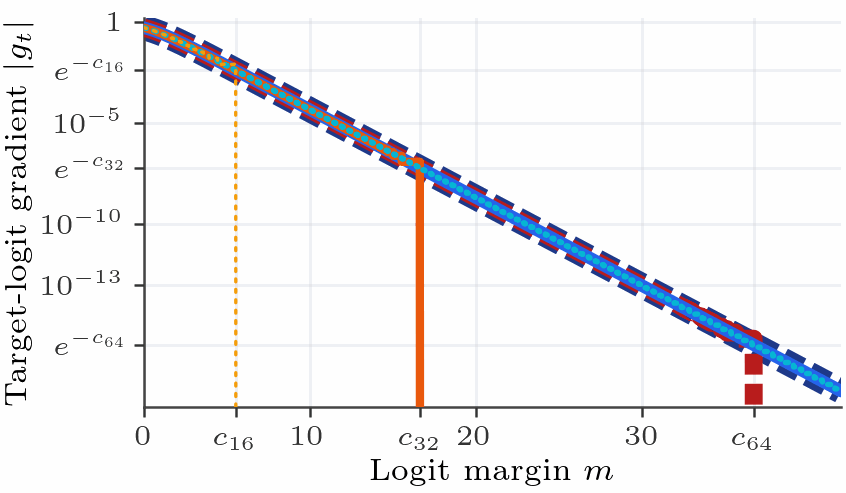
The first bug, identified by Prieto et al. (2025) as Softmax Collapse (Figure 1a), occurs when a model correctly predicts the target class with high confidence, so that is much larger than all non-target logits (). We measure this confidence by the logit margin, which is how much larger the target logit is than the log-sum-exp of all non-target logits:
In Equation 1, subtracting sets the shifted target logit to (so in the denominator), while the non-target exponentials sum to a small positive number . Floating-point numbers have much finer precision near than near : in fp32, values near can be as small as , whereas values added to are lost to rounding below . Because standard implementations form the denominator by adding to , the term is lost to rounding once the margin exceeds a threshold that we will call the precision cliff ( in bf16, in fp32, and in fp64). When , the denominator evaluates to exactly , which causes to evaluate to and zeroes out both the loss and the target gradient . However, the non-target gradients () are evaluated near without adding to their numerators, so they remain positive down to exponent underflow (). Because the target gradient rounds to while the non-target gradients do not, the gradients no longer sum to zero (). When training with adaptive optimizers such as Adam and AdamW (Kingma & Ba, 2015; Loshchilov & Hutter, 2019), which normalize each gradient by a moving average of its magnitude, this asymmetry causes the recurring “slingshot” loss spikes (Thilak et al., 2022; Liu et al., 2026) and stalls grokking (Prieto et al., 2025). While prior works used surrogate losses (Prieto et al., 2025), gradient projection (Liu et al., 2026), or fp64 casting (Nanda et al., 2023; Varma et al., 2023) to ameliorate these issues, we instead fix log-softmax, softmax, and cross-entropy directly (Section 2).
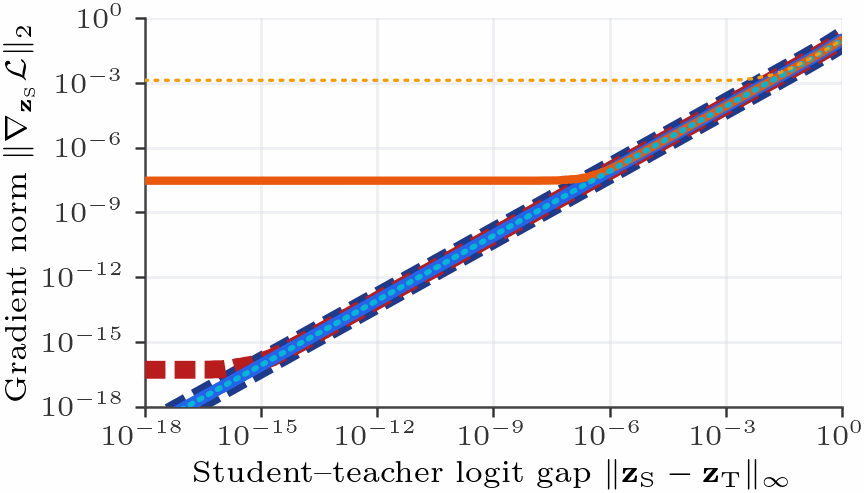
The second bug, which we will call Softmax Cancellation (Figure 1b), occurs in knowledge distillation (Hinton et al., 2015) and KL regularization, where the target comes from teacher logits . Standard implementations compute and separately and subtract them to get . When is close to , subtracting these nearly equal probabilities loses precision, and slight differences between the forward-pass softmax and backward-pass log-softmax formulas leave a non-zero gradient even when . We fix this by computing directly from in log space (Section 3).
2. Softmax Collapse#
When the target logit is the largest logit, shifting by in Equation 1 sets and for , so the denominator is . Mathematically, the hard-target loss is , with gradients
which sum to zero (). In floating point, however, the two expressions for in Equation 3 behave very differently once , where is too small to change when added to it (Figure 1a). Standard implementations form the denominator , which rounds to when (Prieto et al., 2025). In the forward pass, evaluates to , so both and round to zero. In the backward pass, standard implementations compute and subtract to get . In contrast, our fixed expression keeps in the numerator: even when the denominator rounds to , dividing by preserves down to exponent underflow ().
While rounds to zero when , the non-target gradients do not. For each non-target class , standard cross-entropy computes . Because the numerator is evaluated directly from without adding , it remains accurate down to exponent underflow while the denominator rounds to . When , standard cross-entropy zeroes out only the target entry while all non-target gradients remain positive (Liu et al., 2026):
The same bug affects standalone (Qiu & Yao, 2026): once , its backward pass rounds () to and zeroes while the other gradients stay non-zero.
This bug can be fixed by never adding to directly. In and , only the largest logit is shifted to (where in the denominator). Instead of including in the sum of exponentials, we set , compute the margin by excluding from the log-sum-exp (Blanchard et al., 2021), and combine them with a numerically stable (with ):
For hard-target cross-entropy with target , we can use directly in place of without an :
Because the -th slot is replaced with the constant rather than , only appears in through the differences (), so autodiff correctly computes the target gradient as the negated sum of the non-target gradients:
Here is a JAX implementation of log-softmax, softmax, and hard-target cross-entropy, which evaluates via , remains accurate down to exponent underflow, and satisfies :
import jax, jax.numpy as jnp, optax

def log_softmax(z):
  i_max = jnp.argmax(z, axis=-1)
  z_max = jnp.take_along_axis(z, i_max[..., None], axis=-1)  # Max logit.
  is_max = jax.nn.one_hot(i_max, z.shape[-1], dtype=bool)    # Max mask.
  shifted = jnp.where(is_max, 0.0, z - z_max)                # Exact 0 at argmax.
  exp_others = jnp.where(is_max, 0.0, jnp.exp(shifted))      # Non-max exp.
  s = jnp.sum(exp_others, axis=-1, keepdims=True)            # Sum non-max exp.
  return shifted - jnp.log1p(s)                              # log_softmax(z).

softmax = lambda z: jnp.exp(log_softmax(z))

def cross_entropy(z, t):
  z_t = jnp.take_along_axis(z, t[..., None], axis=-1)        # Target logit.
  is_t = jax.nn.one_hot(t, z.shape[-1], dtype=bool)          # Target mask.
  shifted = jnp.where(is_t, 0.0, z - z_t)                    # Exact 0 at target.
  b = jnp.max(shifted, axis=-1, keepdims=True)               # Max shift >= 0.
  s = jnp.sum(jnp.where(is_t, 0.0, jnp.exp(shifted - b)), axis=-1)
  return b[..., 0] + jnp.log1p(s + jnp.expm1(-b[..., 0]))    # -log_softmax(z)_t.
As an example, consider and .
The standard jax.nn and optax implementations return zero for
the target log-probability, loss, and target gradient, while our functions
return accurate values whose gradients sum to zero:
z, t = jnp.array([9.0, -9.0, -9.0], dtype=jnp.float32), jnp.array(0)
std_ce = optax.softmax_cross_entropy_with_integer_labels
jax.nn.log_softmax(z)                       # ->           [ 0.0,      -18.0,     -18.0    ]
jax.grad(lambda z: jax.nn.softmax(z)[0])(z) # ->           [ 0.0,      -1.523e-8, -1.523e-8]
jax.value_and_grad(std_ce)(z, t)            # -> 0.0,      [ 0.0,       1.523e-8,  1.523e-8]
log_softmax(z)                              # ->           [-3.046e-8, -18.0,     -18.0    ]
jax.grad(lambda z: softmax(z)[0])(z)        # ->           [ 3.046e-8, -1.523e-8, -1.523e-8]
jax.value_and_grad(cross_entropy)(z, t)     # -> 3.046e-8, [-3.046e-8,  1.523e-8,  1.523e-8]
3. Softmax Cancellation#
Given student logits and teacher logits , standard soft-target cross-entropy computes and evaluates
As the student logits approach the teacher logits (), the true gradient shrinks toward and equals when . In floating point, however, computing and separately and subtracting them (Equation 8) loses precision when is close to , because the small logit difference is lost when and are rounded to probabilities before being subtracted (Figure 1b). Furthermore, because in the forward pass and in the backward pass are evaluated using slightly different sequences of operations, and do not match to machine precision even when , leaving a non-zero gradient .
To avoid subtracting nearly equal probabilities, we pass directly to our loss function and compute in log space using and . Given , we center under and write the log-ratio and difference as:
Because and , the
input to is always non-negative.
When , we fall back to to avoid if rounds to
while overflows, and we set so that .
Because Equation 9 avoids adding or subtracting ,
remains accurate as and is when .
Here is a JAX implementation of soft-target cross-entropy (using
log_softmax and softmax from Section 2), which
uses jax.lax.stop_gradient (sg) to return the forward loss
while substituting in the backward pass:
def soft_target_cross_entropy(z_S, z_T):
  log_q = log_softmax(z_S)
  q, p = jnp.exp(log_q), softmax(z_T)
  delta = z_S - z_T                                                    # Logit difference.
  d = delta - jnp.sum(p * delta, axis=-1, keepdims=True)               # Center under p.
  s = d - jnp.log1p(jnp.sum(p * jnp.expm1(d), axis=-1, keepdims=True)) # log(q / p).
  u = jnp.where(jnp.abs(s) < 1, p * jnp.expm1(s), q - p)               # Difference q - p.
  g = u - q * jnp.sum(u, axis=-1, keepdims=True)                       # Ensure sum(g) = 0.
  sg = jax.lax.stop_gradient
  loss = -jnp.sum(p * sg(log_q), axis=-1)                              # Forward loss.
  return loss + jnp.sum(sg(g) * (z_S - sg(z_S)), axis=-1)              # Custom gradient g.
As an example, let be a small fp32 perturbation of . Standard soft-target cross-entropy shrinks the second gradient entry by nearly , flips the sign of the third, and fails to sum to zero, while our implementation matches the exact fp64 gradient:
z_T = jnp.array([2.0, 1.0, 0.0], dtype=jnp.float32)
z_S = z_T + jnp.array([-1e-7, 1e-7, 0.0], dtype=jnp.float32)
std_soft_ce = lambda z_S, z_T: -jnp.sum(jax.nn.softmax(z_T) * jax.nn.log_softmax(z_S))
jax.grad(std_soft_ce)(z_S, z_T)               # -> [-5.960e-8, 1.452e-8, -1.123e-9]
jax.grad(soft_target_cross_entropy)(z_S, z_T) # -> [-4.596e-8, 4.144e-8,  4.513e-9]
# Exact (float64) gradient:                        [-4.596e-8, 4.144e-8,  4.513e-9]
4. The Slingshot Mechanism#
In grokking (Power et al., 2022), a network quickly memorizes the training set () and generalizes much later. While studying grokking on modular addition with Adam (Kingma & Ba, 2015; Loshchilov & Hutter, 2019), Thilak et al. (2022) observed the slingshot mechanism, where training after memorization alternates between flat loss plateaus near zero and sudden loss spikes that coincide with jumps in test accuracy.
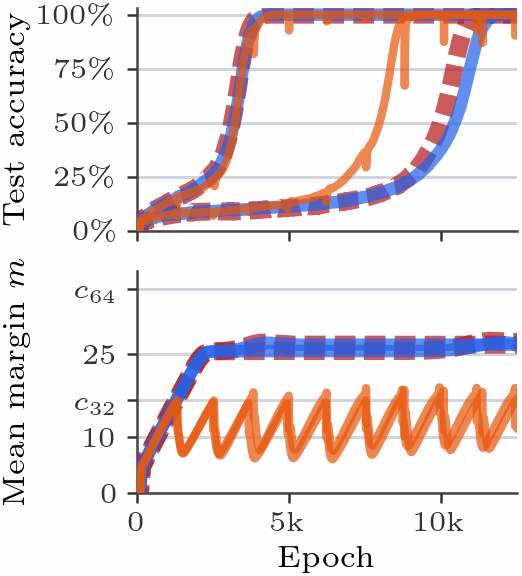
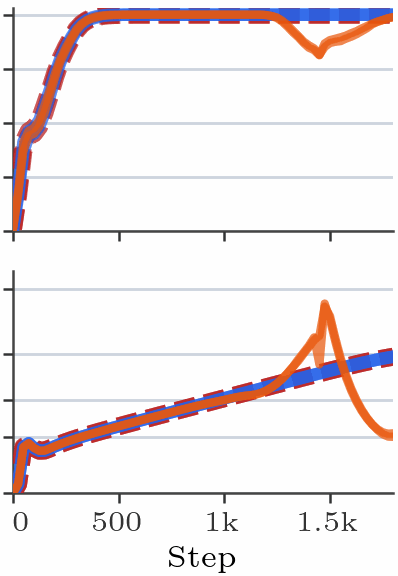
These slingshot spikes are a direct consequence of Softmax Collapse (Section 2, Prieto et al. (2025); Liu et al. (2026)). Recall that AdamW updates parameters by subtracting , where and are bias-corrected moving averages of the parameter gradient and its square (with decay rates ). After memorization, the logit margins grow as the network pushes its target probabilities toward . Once an example’s margin exceeds the precision cliff , standard cross-entropy rounds its target gradient to zero while its non-target gradients () remain positive. When all examples in a batch sit above , the parameter gradients nearly vanish and Adam’s second moment decays exponentially toward zero while weight decay slowly shrinks the parameters. Eventually, weight decay or the residual non-target updates pull a few examples back below , where their target gradients abruptly turn back on. Because decayed while those examples were above , Adam divides the restored gradients by a very small denominator , producing a large parameter step that spikes the training loss, resets , and repeats the cycle. With our fixed cross-entropy, the target-logit gradient does not round to zero at , so and decay smoothly together and slingshot spikes disappear (Figure 2).

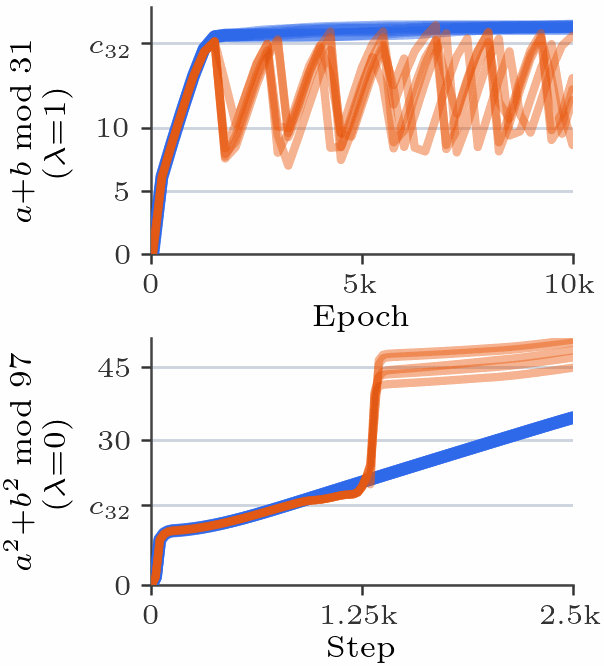
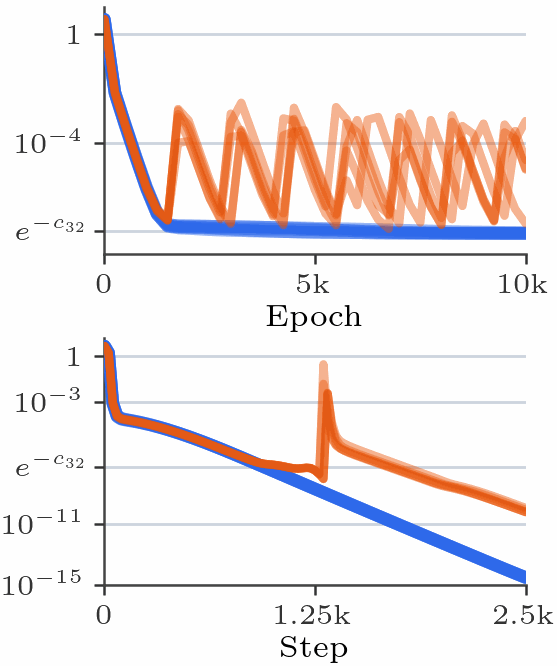
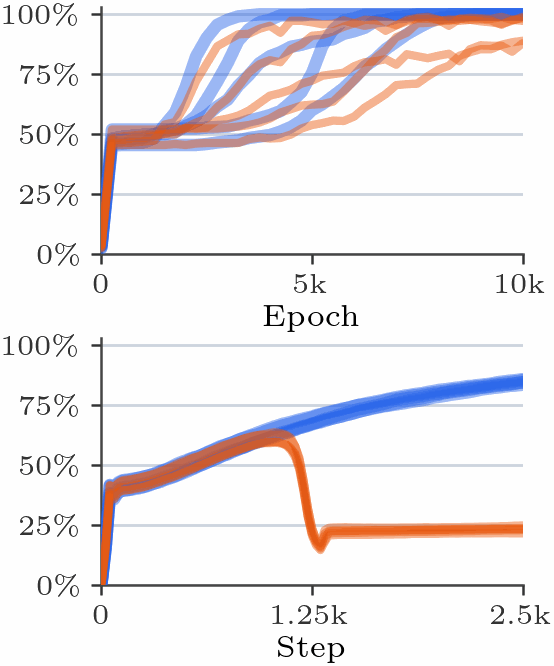
Whether slingshot spikes appear to help or hurt generalization depends on how the network’s weight norm is controlled (Figure 2). When a network uses LayerNorm before the output layer and no weight decay (Thilak et al., 2022; Prieto et al., 2025), growing the pre-LayerNorm weights does not change the logits, but it does shrink the effective step size ; each slingshot spike inflates and acts as an accidental learning-rate decay. When weight norms are already controlled by weight decay (Varma et al., 2023), slingshot spikes at only slow down and hurt grokking ( vs. test accuracy on ; Figure 2, top). And when neither LayerNorm nor weight decay is used (Doshi et al., 2024), a single slingshot spike at is destructive: on (, ), standard cross-entropy tracks fixed cross-entropy up to test accuracy until hits around step , where a spike drops test accuracy to (and from to on ), while fixed cross-entropy continues smoothly to (Figure 2, bottom).
5. Margin Equilibria#
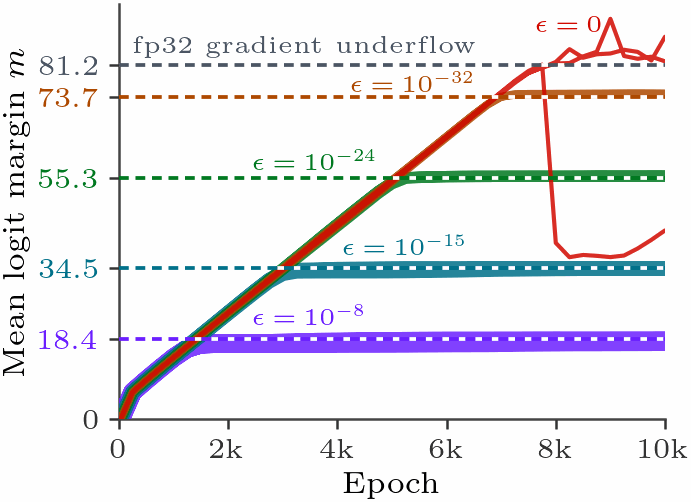
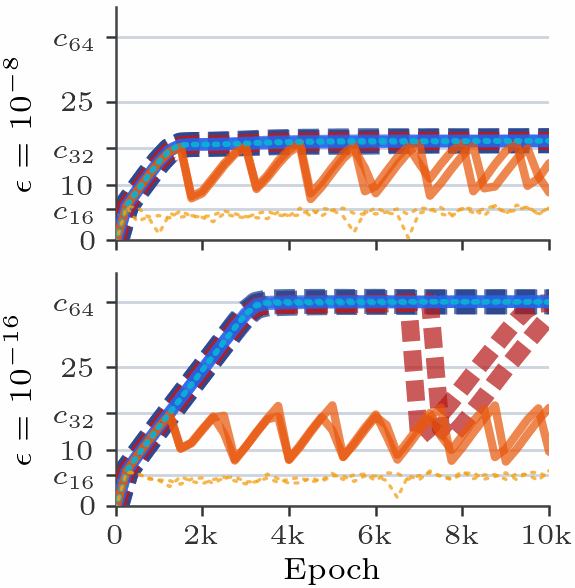
In Figure 2a, our fixed cross-entropy eliminates the precision cliff at , yet with weight decay (, top) its margin still saturates just above near , whereas without weight decay (, bottom) its margin continues to climb. This plateau is the equilibrium where weight decay balances AdamW’s normalized gradient step. At a stationary point where the parameters stop changing, the moving averages converge to and (so ), and setting the update to zero gives:
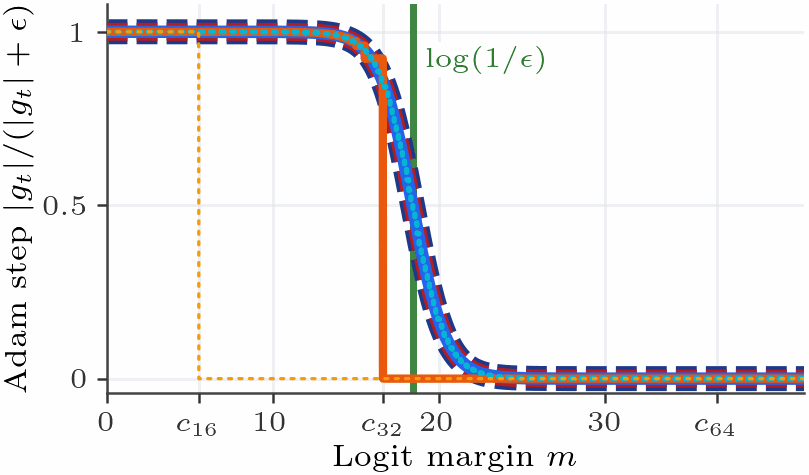
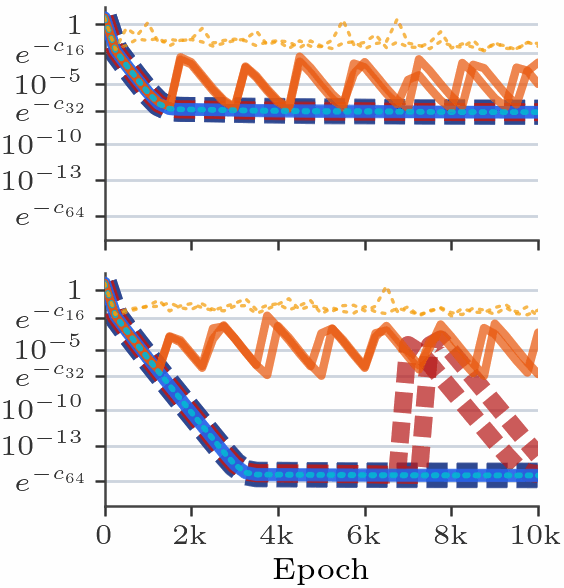
Here , , and cancel out, so RMSProp (Tieleman & Hinton, 2012) and LaProp (Ziyin et al., 2020) share the same stationary point. After memorization, the gradients shrink exponentially with the margin (). If , the normalized gradient has a magnitude of no matter how small becomes, which causes the margin to grow until the gradients underflow. When , however, the normalized gradient has magnitude while , and shrinks as once (Figure 3). Balancing this shrinking step against weight decay requires (Wortsman et al., 2024; Molybog et al., 2023; Everett et al., 2024; Kosson et al., 2024), which acts like an regularizer with weight (Rosset et al., 2004; Soudry et al., 2018). Since , the margin stops growing at:
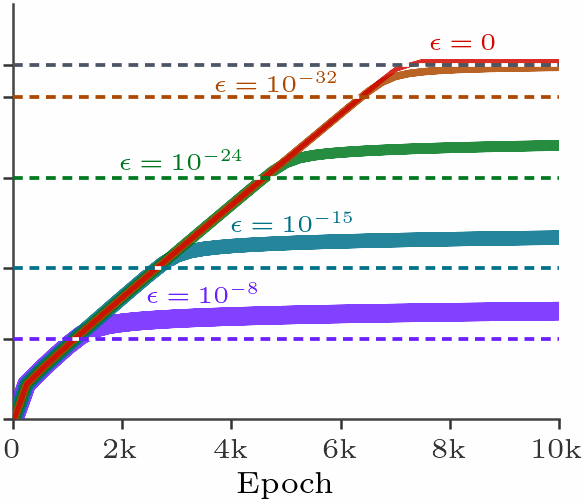
Equation 11 explains why the default causes slingshot spikes in fp32: its equilibrium sits just above (Figure 3), so standard cross-entropy hits the cliff before equilibrium (whereas for , and standard cross-entropy settles without spiking). To test Equation 11 across many orders of magnitude down to in fp32 (Figure 4), we train with our fixed cross-entropy and LaProp on , updating directly without squaring (which underflows in fp32 once , or ). With weight decay (, Figure 4a), the margin for each climbs along the trajectory and levels off at , while grows until the fp32 gradients underflow at . Without weight decay (, Figure 4b), nothing balances the step, so margins keep rising past .

6. Grokking Across Precisions and Benchmarks#
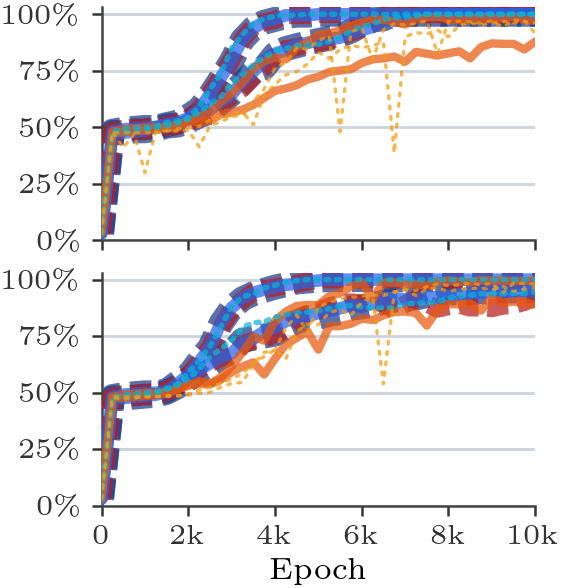
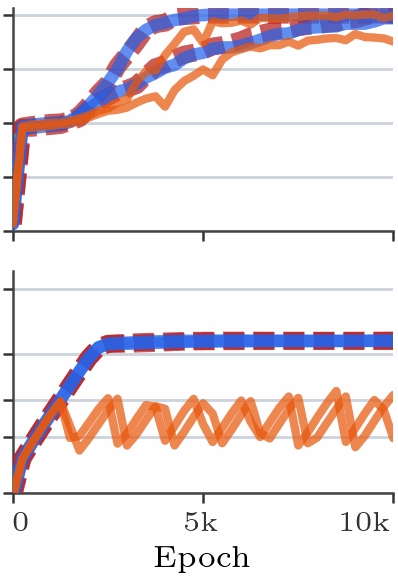
To see how the precision cliff behaves across floating-point formats, we follow Varma et al. (2023) and Lyle et al. (2025) and train a 1-layer, 4-head, width- ReLU Transformer without LayerNorm on ( training split) for epochs of full-batch AdamW (, , , ), varying the loss (standard vs. fixed cross-entropy), logit precision at the loss (bf16, fp32, fp64), and (Figure 5, Table 1). At (Figure 5, top), standard cross-entropy stalls at in bf16 and repeatedly spikes at in fp32, whereas fixed cross-entropy crosses both cliffs smoothly to and reaches test accuracy in all three precisions. Reducing to (Figure 5, bottom) raises the equilibrium to , breaking even fp64 standard cross-entropy at while fixed cross-entropy converges smoothly across all precisions.
Table 1 summarizes these results and compares against two recent methods that modify the gradients or loss to mitigate Softmax Collapse. Liu et al. (2026) subtract the mean logit gradient from each entry so the gradients sum to zero (“Zero-sum Proj.”), which eliminates slingshot spikes. However, once and , subtracting the mean only gives the target logit of the total non-target gradient, stalling near and dropping test accuracy below for . Prieto et al. (2025) propose “StableMax,” which replaces in softmax with a piecewise rational function ( for and for ). Because this function grows linearly instead of exponentially, logit margins blow up to and test accuracy lags our fixed cross-entropy across all .
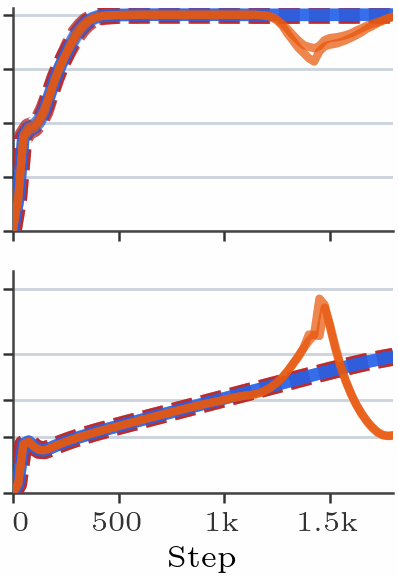
We observe the same behavior across four grokking benchmarks at (Figure 6): 1-layer Transformers on (Nanda et al., 2023) and (Varma et al., 2023) with , and 2-layer MLPs on and (Doshi et al., 2024) with . On all four tasks, fp32 standard cross-entropy spikes once it hits , whereas fp32 fixed cross-entropy matches fp64 standard cross-entropy and reaches test accuracy.
| Test Accuracy (%) | Final Margin | ||||||||||||
|---|---|---|---|---|---|---|---|---|---|---|---|---|---|
| Variant | |||||||||||||
| fp32 | Fixed CE | 100.0 | 0.0 | 99.6 | 0.7 | 99.0 | 2.3 | 17.9 | 27.4 | 36.8 | |||
| fp32 | Standard CE | 94.3 | 5.4 | 96.4 | 5.1 | 96.5 | 4.3 | 13.0 | 15.1 | 12.7 | |||
| bf16 | Fixed CE | 100.0 | 0.1 | 99.8 | 0.2 | 98.9 | 2.4 | 17.9 | 27.4 | 36.8 | |||
| bf16 | Standard CE | 93.3 | 7.4 | 94.9 | 4.9 | 94.2 | 8.3 | 5.1 | 5.6 | 5.8 | |||
| fp64 | Fixed CE | 100.0 | 0.0 | 99.5 | 1.1 | 99.0 | 2.0 | 17.9 | 27.4 | 36.8 | |||
| fp64 | Standard CE | 100.0 | 0.0 | 100.0 | 0.1 | 97.2 | 3.2 | 17.9 | 27.4 | 30.1 | |||
| fp32 | Zero-sum Proj. (Liu et al., 2026) | 97.9 | 3.2 | 48.9 | 2.6 | 49.3 | 2.5 | 17.0 | 18.9 | 18.9 | |||
| fp32 | StableMax (Prieto et al., 2025) | 97.3 | 4.7 | 95.6 | 2.0 | 97.3 | 4.3 | 3200 | 5661 | 6313 | |||
| fp64 | StableMax (Prieto et al., 2025) | 97.4 | 4.2 | 96.7 | 5.3 | 95.6 | 2.7 | 3170 | 21252 | 2322 | |||

7. Soft-Target Distillation#
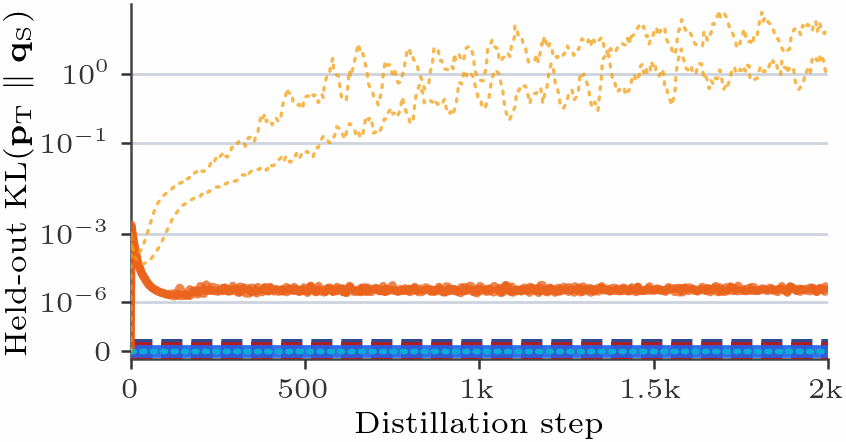
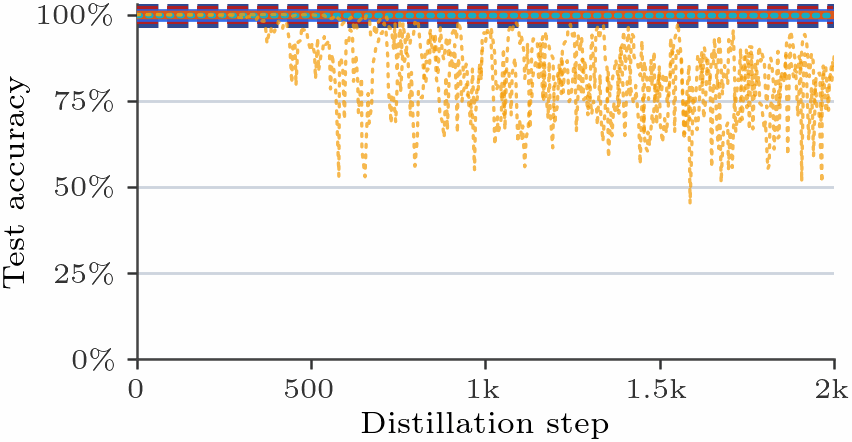
To see how Softmax Cancellation (Section 3) affects optimization, we initialize a 2-layer ReLU MLP student with the fp32 weights of a teacher trained to accuracy on (), and run full-batch steps of Adam (, , , , ) on the training split at temperature (Hinton et al., 2015) (which keeps so does not round to one-hot), computing the forward pass and loss in bf16, fp32, or fp64. Because initially, the true gradient is zero and the student should not move. However, standard soft-target cross-entropy has a non-zero residual gradient at due to the mismatch between its forward softmax and backward log-softmax (Figure 1b). Because Adam divides by , it amplifies even tiny residual gradients (Figure 7): in bf16 () it drives the student away from the teacher and degrades test accuracy, in fp32 () it causes an initial spike and a floor, and in fp64 () the update is too small to change the fp32 weights. Our fixed soft-target cross-entropy returns at , so the student stays at and accuracy across all precisions.

8. Conclusion#
We have presented simple fixes for two numerical bugs in standard implementations of softmax, log-softmax, and cross-entropy: Softmax Collapse, which zeroes out the dominant logit’s gradient at high confidence while leaving non-dominant gradients non-zero, and Softmax Cancellation, which loses precision when student logits approach teacher logits in soft-target distillation. Rewriting these functions in log space using , , and restores accurate, zero-sum gradients across bf16, fp32, and fp64 without internally casting to higher precision. Fixing these bugs eliminates slingshot loss spikes during grokking, prevents student networks from drifting away from the teacher during distillation, and reveals that logit margins under AdamW and weight decay naturally converge to . Though the extreme margins and near-zero student–teacher gaps probed by our experiments are uncommon in standard large-scale training, our fixed functions are easy drop-in replacements that can be implemented without meaningful slowdown, and may prove useful whenever models make high-confidence predictions or distill from close teachers.
Acknowledgments: We thank Jean-Baptiste Alayrac, Forrester Cole, Roy Frostig, Mark Hamilton, Muhammad Maaz, Miki Rubinstein, Keith Rush, and Brandon Zhao for their helpful advice.
Errata: In an earlier version of this paper, the code in Section 2 produced gradients when all but one logit was effectively , as happens with masking in causal attention or with extreme logits. This bug was not present in our internal codebase, which produced all results in this paper. It appears to have been introduced by an over-eager agent that simplified our code for this paper, likely in an attempt to match Equations 5 and 6 (with , can be written as or equivalently as , but the latter makes autodiff differentiate through when ). We thank Maaz (2026) for identifying this issue.
References#
- [Blanchard et al., 2021] Accurately computing the log-sum-exp and softmax functions. IMA Journal of Numerical Analysis, 2021.
- [Doshi et al., 2024] Grokking modular polynomials. arXiv:2406.03495, 2024.
- [Everett et al., 2024] Scaling exponents across parameterizations and optimizers. ICML, 2024.
- [Higham, 2002] Accuracy and stability of numerical algorithms. SIAM, 2nd edition, 2002.
- [Hinton et al., 2015] Distilling the knowledge in a neural network. arXiv:1503.02531, 2015.
- [Kingma & Ba, 2015] Adam: A method for stochastic optimization. ICLR, 2015.
- [Kosson et al., 2024] Rotational equilibrium: How weight decay balances learning across neural networks. ICML, 2024.
- [Liu et al., 2026] Grokking or glitching? How low-precision drives Slingshot loss spikes. arXiv:2605.06152, 2026.
- [Loshchilov & Hutter, 2019] Decoupled weight decay regularization. ICLR, 2019.
- [Lyle et al., 2025] What can grokking teach us about learning under non-stationarity? Conference on Lifelong Learning Agents, 2025.
- [Maaz, 2026] Property-based testing for robust softmax and cross-entropy. arXiv:2610.36427, 2026.
- [Molybog et al., 2023] A theory on Adam instability in large-scale machine learning. arXiv:2304.09871, 2023.
- [Nanda et al., 2023] Progress measures for grokking via mechanistic interpretability. ICLR, 2023.
- [Power et al., 2022] Grokking: Generalization beyond overfitting on small algorithmic datasets. arXiv:2201.02177, 2022.
- [Prieto et al., 2025] Grokking at the edge of numerical stability. ICLR, 2025.
- [Qiu & Yao, 2026] Why low-precision Transformer training fails: An analysis on Flash Attention. ICLR, 2026.
- [Rosset et al., 2004] Margin maximizing loss functions. NeurIPS, 2004.
- [Soudry et al., 2018] The implicit bias of gradient descent on separable data. JMLR, 2018.
- [Thilak et al., 2022] The Slingshot mechanism: An empirical study of adaptive optimizers and the grokking phenomenon. arXiv:2206.04817, 2022.
- [Tieleman & Hinton, 2012] Lecture 6.5—RMSProp: Divide the gradient by a running average of its recent magnitude. COURSERA: Neural Networks for Machine Learning, 2012.
- [Varma et al., 2023] Explaining grokking through circuit efficiency. arXiv:2309.02390, 2023.
- [Wortsman et al., 2024] Small-scale proxies for large-scale Transformer training instabilities. ICLR, 2024.
- [Ziyin et al., 2020] LaProp: Separating momentum and adaptivity in Adam. arXiv:2002.04839, 2020.